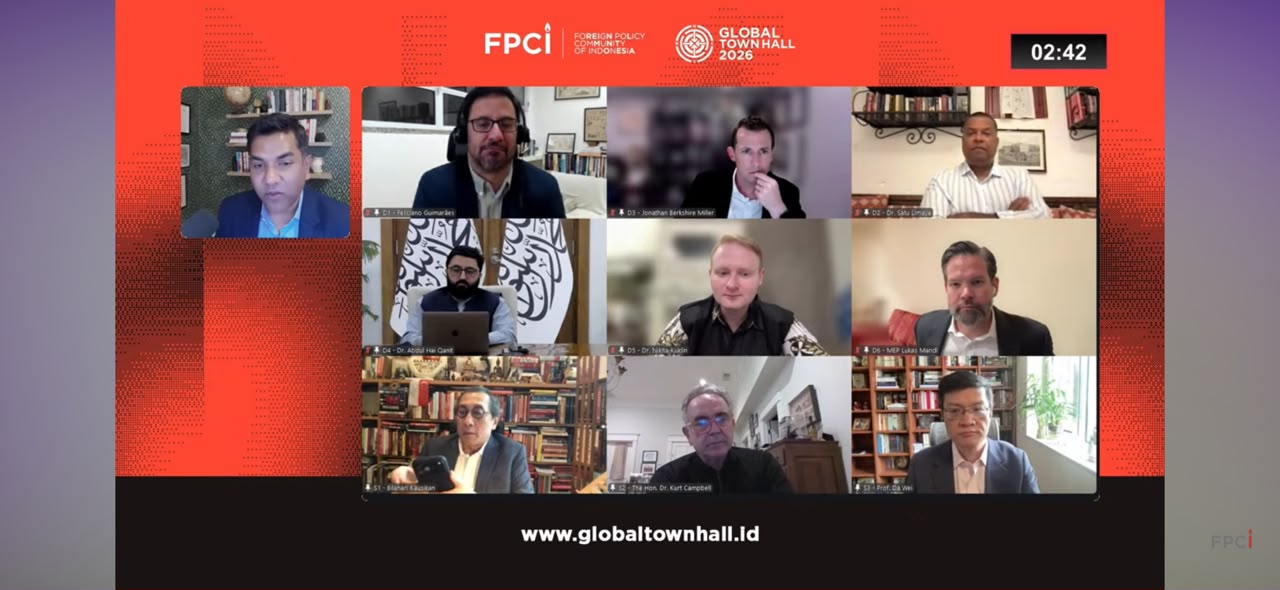
Jakarta, 19 September 2026 – Foreign Policy Community of Indonesia (FPCI) convened its annual Global Town Hall 2026 on Saturday, 19 September 2026. This global virtual conference serves as an independent platform for civil society, academics, thinkers, and journalists from around the world to engage in dialogue on some of the most pressing issues of our time. This year, the virtual people-to-people global forum brings the theme of “Calling for a Global U-Turn: Recentering Development, Reclaiming Humanity, Restoring Justice in a Crazi(er) World.”
Amid the various global crises, one special session that is particularly crucial to follow is the special session on Palestine, titled “From Aspiration to Reality: Prospects and Challenges for Palestinian Independence and Statehood.”
Palestine’s path toward independence remains fraught with challenges. Uncertainty and escalating conflict continue to overshadow the lives of millions. Against this backdrop, the session is not merely an academic discussion, but a space to hear directly from those living and struggling on the frontlines of this reality.
The panelists who participated in this session included prominent figures, such as:
Keynote Speakers:
- H.E. Dr. Varsen Aghabekian Shahin, Minister of Foreign Affairs and Expatriates of the State of Palestine
Special Remarks:
- H.E. Jusuf Kalla, Vice President of the Republic of Indonesia (2004–2009, 2014–2019)
Panelists:
- H.E. Nickolay Mladenov, High Representative for Gaza – Board of Peace
- Daniel Levy, President of the U.S. / Middle East Project (USMEP)
- Wadah Khanfar, President of Al Sharq Forum
- Moderator: Nathalie Tocci, Professor of Practice at the Johns Hopkins School of Advanced International Studies (SAIS)
Discussants:
- Michael Vatikiotis, Writer and Private Diplomat
- Yenny Wahid, Director of Wahid Foundation
- Amb. Tarek Adel, Former Assistant Foreign Minister for Arab Region Affairs (2015–2016)
- Jismi Johari, President of Malaysian Humanitarian Aid and Relief (MAHAR); Chairman of Ops Ihsan
- Muhammed Hüseyin Mercan, Associate Professor of International Relations at Ankara Yıldırım Beyazıt University, Türkiye
- Dr. Qamar Cheema, Executive Director at Sanober Institute
H.E. Dr. Varsen Aghabekian Shahin, Minister of Foreign Affairs and Expatriates of the State of Palestine, opened the session by sharing her keynote remarks as she carries the message that truly represents the state of the Palestinian people:
“For Palestinians, statehood is not an abstract diplomatic aspiration, nor is it a reward to be granted at the end of an indefinite political process. The Palestinian people possess an inalienable right to self-determination, and the State of Palestine is a political, legal, and national reality. What remains denied is our ability to exercise full sovereignty over our territory because of Israel’s illegal occupation. The full realization of Palestinian sovereignty and independence, therefore, depends first and foremost on ending the occupation and reversing the policies that are destroying the territorial, political, and economic foundations of the two-state solution.”
One of the panelists representing the Board of Peace, H.E. Nickolay Mladenov, High Representative for Gaza – Board of Peace, discusses the political roadmap for the future of Gaza and Palestinian statehood:
“Our goal is not to separate Gaza from the West Bank. Our goal is indeed to return Gaza to the control of their own Palestinian National Authority in Ramallah. But to do that, we need to take very, very important steps now. And these steps cannot be taken without Israel, without Egypt, without the Palestinians, without the broader international community. And that is why my focus right now is exactly on that. It is on how we cross this important threshold that we’re facing now between the planning phase and the phase in which these steps will be realised. The transition in terms of civilian authority, the transition in terms of the decommissioning of weapons, Israeli withdrawal to the perimeter of Gaza in order to be able to bring back the political talks that are so important for this file. Because Gaza is not just a humanitarian file. It is a very, very political file for everyone, for Palestinians as well, for this very reason, for the rest of the region.”
H.E. Jusuf Kalla, Vice President of the Republic of Indonesia (2004–2009, 2014–2019), shared his special remarks for this session; he emphasized and acknowledged that:
“The Board of Peace does have a concept that represents something of a middle ground—but it isn’t fully accepted by Israel, nor fully accepted by the Palestinian side. That’s because the Board of Peace’s proposal still calls for a two-state solution, which is also something Israel does not agree to […] Yes. The solution most widely acceptable to all parties is the two-state solution. It upholds the principle of dignity for all, meaning Palestine is recognized, and Israel is recognized as well. To reach the borders we see today, this happened because previously, the Palestinian side did not recognize the state’s borders. Now, with this kind of situation, with a recognized two-state solution, the state borders would also be recognized.”
One of the panelists for this session—Daniel Levy, President of the U.S. / Middle East Project (USMEP), grounded the session’s discussion by bringing everyone’s attention back to what truly matters:
“For Palestinians, there is no predictability to daily life under Israeli occupation. Most Gazan is still occupied; the West Bank is facing more severe destruction than it has for many decades. Right now, Israelis will vote next month in an election. Do you know what’s not on the ballot? Not one single zionist party is advocating two states–there’s not one single zionist party in Israel saying they advocate and support two states. I would suggest two states have had its day; one is that reality everyone should be equal in that one state. But there’s no such thing as a violent occupation that does not generate resistance, so you can decommission those weapons and then resistance will come back because that is the nature of what violent illegal colonial occupations lead to.”
The session was broadcast globally, connecting audiences and speakers from Palestine (Ramallah), Qatar, the United Arab Emirates, Türkiye, Egypt, the United Kingdom, Italy, and across Asia.
About Global Town Hall 2026
Global Town Hall is an independent, open platform that connects civil societies from around the world and engages them in meaningful discussions about issues that affect daily life. It is a genuine people-to-people platform, and it is a dialogue of the people, by the people, and for the people. This year, more than 8,300+ participants from over 120+ countries have registered to attend and share their perspectives in this global forum.
About the Foreign Policy Community of Indonesia (FPCI)
FPCI is Indonesia’s largest foreign policy community and one of the largest in Southeast Asia and the Indo-Pacific, with a network of more than 100,000 people. FPCI is an independent, non-partisan, and non-profit foreign policy organization established to bring foreign policy issues to the grassroots level, with a mission to shape and promote positive internationalism in Indonesia and around the world.